How the Multi-Functional Bedroom Shapes Sleep and Recovery

When the Multi-Functional Bedroom Stops Being a Place of Rest
For many people today, the Multi-Functional Bedroom no longer serves a single purpose. What was once a place reserved for sleep has quietly expanded into a Multi-Functional Bedroom that also functions as an office, a study, and a space for scrolling, worrying, and thinking. This shift turns the Multi-Functional Bedroom into an environment that hosts mental effort, emotional processing, and prolonged attention, something the body does not experience as harmless.
Those who work or study from a Multi-Functional Bedroom often report shallow sleep, vivid dreams, and mornings that begin in fatigue rather than restoration. Even after hours spent in bed, the body wakes tense, as if it never fully disengaged. The issue is not stress alone, but a nervous system that no longer recognizes the Multi-Functional Bedroom as a place designed for recovery.
The brain learns through association. Over time, spaces become biologically linked to arousal and effort. When a Multi-Functional Bedroom repeatedly hosts cognitive demand, the body adapts by maintaining vigilance. This is why simply “stopping work” rarely produces real rest in a Multi-Functional Bedroom: the body responds to cues such as light, posture, texture, and visual signals, not intention.
The problem is not the Multi-Functional Bedroom itself. It is the absence of a reliable transition system, a sequence of physical cues that tells the body to shift from activation to rest. What follows is a practical framework for rebuilding those boundaries within a Multi-Functional Bedroom, using signals your nervous system already understands.
Take a look at how Lai Bertodo designed her own cozy room for more soft, layered inspiration this season.
Table of Content
Multi-Functional Bedroom: Designing Clear Zones for Focus and Rest


One of the most common reasons rest feels incomplete in a Multi-Functional Bedroom is that the day never truly ends at a bodily level. From the nervous system’s perspective, finishing work is not the same as closing it. Without a clear physical marker between effort and recovery, the Multi-Functional Bedroom remains neurologically “open.”
Behavioral neuroscience shows that state transitions rely heavily on somatic cues: changes in posture, pressure, and tactile sensation. In a Multi-Functional Bedroom, deciding that it is “time to rest” has little effect if the sensory environment remains unchanged.
This is where an end-of-activity ritual becomes essential in a Multi-Functional Bedroom. Not a rigid routine, but a consistent physical action that signals closure. The most effective rituals share three characteristics:
They involve a tangible bodily change, not a purely mental decision
They create a clear sensory contrast with the activity that came before
They are repeated consistently, allowing the nervous system to learn the pattern
Changing clothing meets all three criteria. Because fabric sits directly on the skin, it is one of the fastest ways to communicate a shift in state within a Multi-Functional Bedroom.


Lightweight sleepwear alters both texture and posture, a crucial shift inside a Multi-Functional Bedroom where the body often remains in work mode. A satin pajama set like the Amie Lace Collar Satin Lightweight Pajama Set does not compress the body; it drapes, moving with it rather than containing it. This subtle shift encourages release after hours of tension accumulated in a Multi-Functional Bedroom. Small details such as a soft neckline or fluid sleeves influence how the shoulders drop and the chest opens, cues that tell the nervous system that effort has ended within the Multi-Functional Bedroom.
Layering can deepen this signal in a Multi-Functional Bedroom. A robe worn intentionally at the beginning or end of the day functions as a boundary object inside a Multi-Functional Bedroom. The Quiet Evening Striped Robe Set, with its plush texture and gentle weight, applies light pressure to the torso sensations associated with parasympathetic activation and rest. Wrapping the fabric and tying the belt becomes a physical declaration that engagement has stopped in a Multi-Functional Bedroom.
Ultimately, the garment itself matters less than consistency. When clothing is reserved exclusively for rest, the body learns the signal automatically, even within a Multi-Functional Bedroom. Over time, these rituals allow the day inside a Multi-Functional Bedroom to close with ease, and sleep to arrive as a response rather than a task. Build your Nighttime Rituals Collection to make this transition effortless each evening
Layers that mark the close of effort, letting the body release tension naturally
Use Texture to Communicate Safety


Once the body learns how to close the day, the next question becomes more fundamental: does the Multi-Functional Bedroom feel safe enough to let go?
Safety, from a nervous system perspective, is not a thought. It is a sensation. And among all sensory inputs, touch is one of the fastest ways the body decides whether vigilance can soften or must remain intact. In a Multi-Functional Bedroom, texture plays a critical regulatory role long before comfort is consciously evaluated.
Tactile information reaches regulatory centers of the brain more quickly than conscious thought. This is why texture matters in a Multi-Functional Bedroom, not as decoration, but as biology. Certain sensations lower baseline alertness almost immediately, while others keep the body subtly braced.
Textures that communicate safety tend to share a few qualities:
- Softness without compression, allowing muscles to release
- Gentle weight that creates contact without restriction
- Dimensional texture that engages the skin continuously rather than sharply
What matters is not only what is touched, but how it touches the body. Layers that wrap or drape over the body play a different role from surfaces that merely support it, especially in a Multi-Functional Bedroom. They act as ongoing sensory communicators, sending repeated signals of containment and ease.


A throw like the Arabella Tassel Throw Blanket illustrates this distinction inside a Multi-Functional Bedroom. Its neutral tone recedes visually, while its waffle weave creates subtle points of contact across the skin. Substantial without being heavy, it conforms to the body rather than pressing into it. When used in a Multi-Functional Bedroom, especially over the shoulders or across the torso, it offers a steady presence the nervous system reads as grounded stillness.
For deeper rest within a Multi-Functional Bedroom, this sensation can extend to a comforter designed for breathability rather than weight. The Plant-Based Duvet Insert Comforter drapes naturally, maintaining warmth without trapping heat. Its lightly quilted surface introduces structure without rigidity, allowing the body to feel held without confinement, an essential balance in a Multi-Functional Bedroom.
This is not about interior styling. In a Multi-Functional Bedroom, it is about teaching the body through repeated, gentle contact what safety feels like. When textures used consistently in a Multi-Functional Bedroom communicate softness, pliancy, and airflow, the nervous system begins to downshift on its own. Explore the Restful Textures Collection to surround your Multi-Functional Bedroom with calm every night.
Textures chosen to invite the nervous system into calm, not command it
Shift Lighting to Exit Focus Mode


If texture tells the body it is safe, light tells the brain what time it is, especially inside a Multi-Functional Bedroom.
Human attention is highly sensitive to visual cues. Brightness, contrast, and color temperature all influence whether the brain remains in focus mode or begins to disengage. This is why many people feel exhausted yet restless at night in a Multi-Functional Bedroom: the body is ready to stop, but the visual environment is still signaling alertness.
Light directly affects hormonal rhythms, particularly the balance between cortisol and melatonin. Cool, bright light mimics daytime conditions. It sharpens attention and increases reactivity, which is useful for work but counterproductive for rest in a Multi-Functional Bedroom.
The issue is not light itself, but the lack of transition. Moving abruptly from intense brightness to darkness gives the nervous system no time to recalibrate. In a Multi-Functional Bedroom, this often leads to restlessness rather than rest
Effective visual regulation relies on gradual shifts :
- Warmer light temperatures that soften cognitive sharpness
- Lower light sources placed below eye level
- Diffuse illumination that reduces contrast and glare


A lamp like the Vintage-Inspired Tilted Umbrella Lamp embodies these principles. Its pleated shade filters light rather than projecting it, while the warm tone softens the visual field. Used in a Multi-Functional Bedroom, the subtle tilt prevents direct glare, creating ambient illumination that feels present but non-demanding.
Candlelight extends this effect through movement. A flame introduces rhythm, a slow visual tempo that contrasts with static artificial light. The Vintage Aesthetic Wooden Wall Mirror & Candlestick Holder amplifies this quality. The warm wood holds visual warmth even before lighting, while the arched mirror reflects glow without increasing intensity. In a Multi-Functional Bedroom, the result is not brightness, but atmosphere.
These changes do not require redesign. They require different signals. When light becomes warmer, lower, and slower, focus mode loosens naturally, discover the Evening Glow Collection to guide your room gently from effort into rest.
Visual cues that ease the transition from wakefulness into night
Protect the Bed as a Recovery-Only Zone


If light guides the brain toward rest, the bed defines what kind of rest is possible in a Multi-Functional Bedroom.
The bed carries one of the strongest biological associations in the home. It is where the nervous system expects surrender where muscle tone drops and vigilance fades. When that expectation is repeatedly violated in a Multi-Functional Bedroom, the body adapts, but at a cost.
From an associative learning perspective, the brain does not distinguish intention from exposure. If the bed becomes a place for emails, deadlines, or prolonged scrolling, it absorbs those signals. Over time, the bed inside a Multi-Functional Bedroom no longer registers as a recovery surface.
Protecting the bed is not about discipline. It is about restoring meaning. What helps the nervous system relearn this boundary is the introduction of sleep-exclusive layers, materials that exist only for rest and never appear during the day in a Multi-Functional Bedroom.


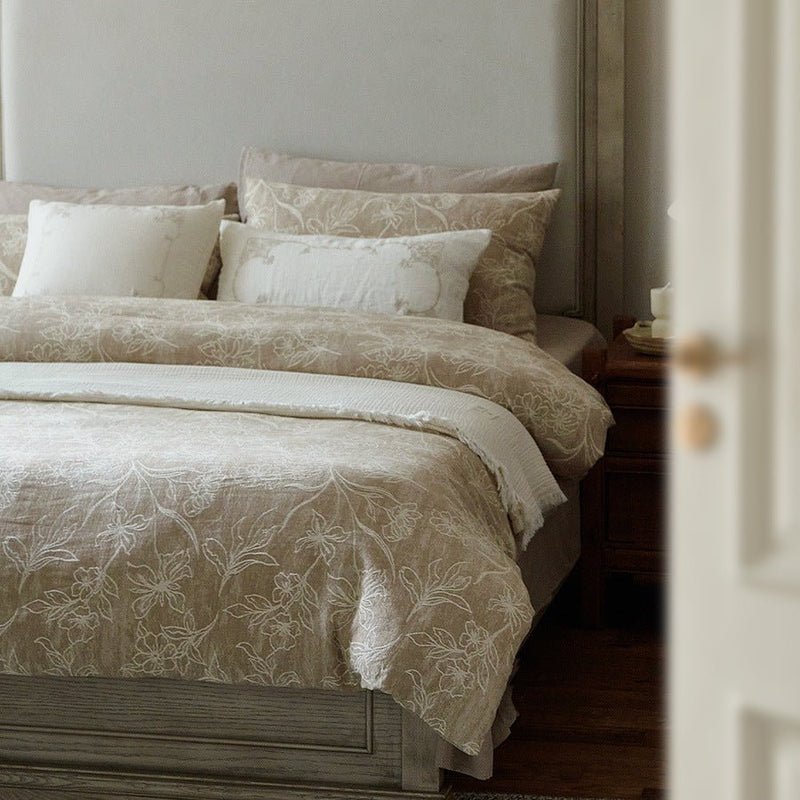
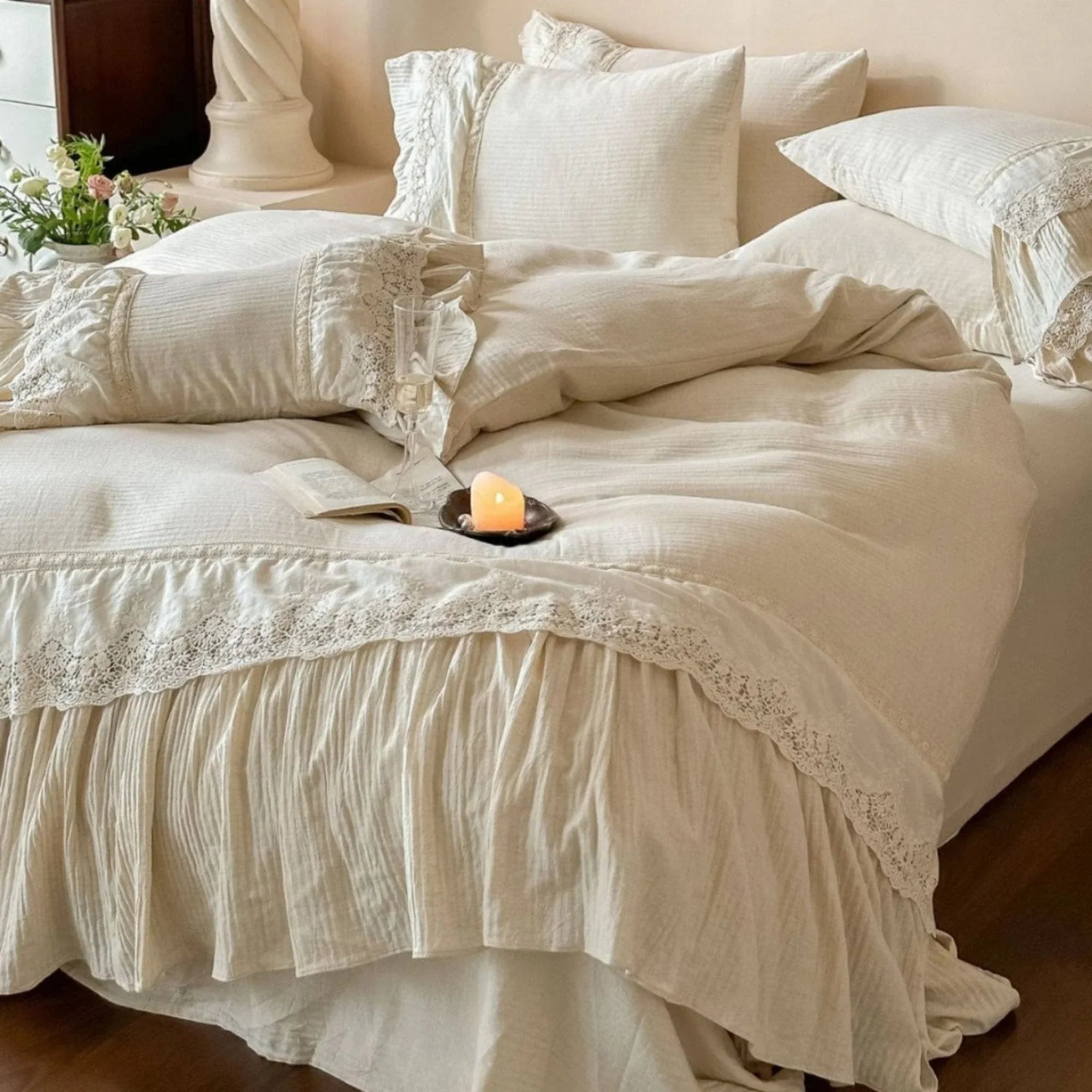
A bedding set like the Evelyn Retro Double Gauze Bedding Set works because it feels distinct. The double gauze cotton is airy yet textured, creating a tactile contrast to the smoother surfaces associated with daytime activity. Its warm, muted tone grounds the visual field, while the naturally crinkled fabric discourages rigidity. In a Multi-Functional Bedroom, this immediate contrast lowers alertness upon contact.
Beneath it, a functional layer can quietly reinforce the message. The Plant-Based Thickened Mattress Protector Fitted Sheet introduces gentle buffering without heat or heaviness. Its tailored fit and quilted surface create a sense of intentional preparation, signaling care rather than convenience within a Multi-Functional Bedroom.
What matters here is the surface beneath the body. The nervous system processes what it lies on more persistently than what briefly touches it. Over time, these repeated cues restore the bed’s original role in a Multi-Functional Bedroom, not as a place where effort continues, but as a place where effort ends. Build your Recovery-Only Bedding Collection to reclaim the bed as a sanctuary of rest.
A bed that speaks the language of recovery, one night at a time
Add Small Anchors That Reinforce Rest


Once the bed has been re-established as a recovery zone, the nervous system becomes more receptive to reinforcement. This is where small anchors matter in a Multi-Functional Bedroom, not as primary solutions, but as stabilizers.
In neuroscience, consistency often outweighs intensity. Small objects, when used exclusively and predictably,become powerful shortcuts for regulation, especially in a Multi-Functional Bedroom where roles often overlap.
Effective anchors share three traits:
- They are used only at night
- They involve direct sensory contact
- They appear at the same moment each evening


An eye mask is one of the most direct examples. Covering the eyes reduces incoming information, narrowing awareness. A Silk Eye Mask introduces quiet through touch: smooth, cool, and frictionless. In a Multi-Functional Bedroom, placing it on becomes a learned cue: when this happens, vigilance releases.
Pillows can function similarly when their role is clearly defined. The French Minimalist Ruffle Pillow, reserved strictly for sleep, becomes a familiar point of contact associated with surrender.Its breathable fabric and restrained structure support without collapse, reinforcing stability rather than stimulation inside a Multi-Functional Bedroom.
What gives these objects power is exclusivity. When certain items appear only at the threshold of sleep, they act as biological punctuation marks. They do not initiate rest but they help the body stay there. These anchors do not solve the problem of a multi-functional bedroom. They secure the solution: quietly, consistently, and without effort, explore the Nighttime Anchors Collection to reinforce rest effortlessly each night.
Objects reserved for night, teaching surrender through touch and ritual
Conclusion


Taken together, these shifts reveal a quieter truth: rest is not something the body can be commanded into, especially inside a Multi-Functional Bedroom. It has to be invited. The nervous system does not reset because a schedule says it should, or because the day has technically ended. In a Multi-Functional Bedroom, rest only emerges when the environment consistently speaks a language the body understands, through touch, light, pressure, temperature, and repetition.
A Multi-Functional Bedroom is not a failure of modern life, nor is it inherently damaging. It is simply a space that carries overlapping demands and therefore requires clearer biological cues. When a Multi-Functional Bedroom provides physical transitions between focus and rest, when textures are chosen to communicate safety, when lighting softens rather than sharpens attention, and when the bed is protected as a recovery-only zone, the nervous system begins to respond differently.
Over time, a well-regulated Multi-Functional Bedroom stops feeling mentally crowded. Sleep becomes less fragile because the body no longer needs to stay alert. Mornings feel less like recovery from effort and more like a continuation of rest. In this way, the Multi-Functional Bedroom transforms from a space of constant activation into a place where focus and restoration can coexist without competing.
Explore a Sanctuary Collection shaped around the body’s natural need for transition, garments, textures, and bedroom elements chosen to signal closure, restore safety, and support the nervous system as it moves from activation into rest.
How Environment, Touch, and Ritual Quietly Steer the Nervous System
The bedroom no longer signals rest automatically. It carries the weight of work, worry, and focus.
The body cannot respond to intention alone; sensory cues govern the shift from alertness to calm.
Without clear transitions, the nervous system remains partially engaged even when the day ends.
Small rituals, like changing into specific sleepwear, can physically mark the close of daily effort.
Textures and tactile sensations communicate safety, encouraging the body to release tension.
Lighting influences hormonal and cognitive states, signaling whether it is time to focus or to rest.
Protecting the bed as a recovery-only space allows the nervous system to relearn what rest feels like.
Looking for another read?


Question related on bedroom sizes:
How does bedroom size affect bed styling ideas?
Bedroom size determines how much layering, texture, and colour your bed can support. Smaller bedroom sizes benefit from minimal layers and lighter fabrics, while larger bedroom sizes allow for deeper textures, wider duvets, and more expressive bed styling ideas. Matching bed styling to bedroom size helps create balance and visual harmony.
What are the best bed styling ideas for small bedrooms?
The best bed styling ideas for small bedrooms focus on simplicity and openness. Use lightweight bedding, limit pillows to one or two, and avoid heavy layering. Light colours such as white, beige, and soft pastels help reflect light and make small bedroom sizes feel more spacious.
How can I style my bed without making my bedroom feel cluttered?
To avoid clutter, choose bed styling ideas that match your bedroom size. Use fewer decorative pillows, keep colour palettes cohesive, and allow fabrics to drape naturally. Avoid overcrowding the bed with accessories, especially in smaller bedroom sizes.
How many pillows should I use based on bedroom size?
For small bedroom sizes, one to two pillows are usually enough. Medium bedroom sizes work well with two sleeping pillows and one or two decorative cushions. Large bedroom sizes, such as those with queen or king beds, can support multiple layered pillows without feeling overwhelming.
Thanks for staying till the end... ♡
Thanks for finishing reading the whole blog!!
Click here to read more inspo blogs. Click here to shop our new arrivals.
♡ Don't forget to share your progress and room makeovers with us by using #EverLastingMakeover #EverLastingFabric and tagging us @EverLastingFabric.
Instagram | Facebook | TikTok | Pinterest | Youtube nighttime routinenighttime routine
nighttime routinenighttime routinenighttime routinenighttime routinenighttime routinenighttime routinenighttime routinenighttime routinenighttime routinenighttime routinenighttime routinenighttime routinenighttime routinenighttime routinenighttime routinenighttime routinenighttime routinenighttime routinenighttime routinenighttime routinenighttime routinenighttime routinenighttime routinenighttime routinenighttime routinenighttime routinenighttime routinenighttime routinenighttime routinenighttime routinenighttime routinenighttime routinenighttime routinenighttime routine