Design Therapy: Why Does My Bedroom Still Feel Cluttered Even When Everything Is Put Away?


Everything is put away. The floor is clear, the laundry is folded, the surfaces have nothing sitting on them that shouldn't be. And the room still feels like a mess.
That gap is the part nobody explains well. You clean, and the room should feel calmer, but it still doesn't, and it's easy to assume you just need to declutter harder. That's usually not it. If your bedroom still feels cluttered after everything is technically put away, the problem probably isn't how much stuff you have. It's how that stuff relates to everything else in the room.
A cluttered bedroom doesn’t have to be messy to feel off. Sometimes the culprit is visual rather than physical, hiding in the way your furniture sits, the number of things you have on display, or the amount of attention each part of the room demands. These five details are easy to overlook, but they can completely change how tidy your bedroom actually feels.
Table of contents
Physical Clutter vs. Visual Clutter: Not the Same Problem


Physical clutter is stuff out of place. Visual clutter is stuff that's in place but still creates too much for your eyes to process at once. This is the distinction, and also the reason a bedroom can feel cluttered even when there's technically nothing to put away.
A shelf with fifteen small, unrelated objects arranged neatly is still visually loud. So is a gallery wall with too many frame styles, or a room where every surface has one decorative item on it, none related to the next. Your brain doesn't just register whether something is tidy, it registers how much it has to sort through to make sense of a space. The more unrelated visual information in a room, the more cluttered it reads, regardless of how organized it actually is.
How to tell if you're dealing with visual clutter, not physical clutter:
- Count the number of small decorative objects visible from the doorway, more than 5–7 usually reads as busy
- Check whether items on the same surface share a color, material, or shape
- Notice if your eye has a clear place to land, or keeps bouncing around the room
- Ask whether the room would still feel calm in a photo, even if it's tidy in person
Grouping small items instead of scattering them is one of the easiest fixes, and something like Hanging Organizer Bag can give loose pieces one shared home instead of five scattered ones.
More pieces that group small items into one calm spot
Too Many Focal Points Compete for Attention


A room needs one clear place for the eye to land first. When a bedroom has a bold headboard, a statement rug, a gallery wall, and a patterned accent chair all competing at once, none of them get to be the focal point, and the room feels cluttered even though each piece is fine on its own.
This is one of the subtlest reasons a bedroom can feel cluttered. Nothing is out of place, there's just too much asking for attention at the same time. The fix isn't removing your favorite pieces, it's letting one of them lead and asking everything else to support it instead of compete with it.
Ways to identify and fix competing focal points:
- Pick one feature to be the "star," usually the bed or a single wall
- Let everything else in the room use quieter colors or simpler shapes
- Avoid pairing two bold patterns in the same sightline
- Step back from the doorway and notice where your eye actually goes first
If you are someone who enjoys bold patterns in your room, and want to avoid it from competing with your wall art or rug, read our guide on "How To Style A Calm Bedroom Using Patterns That Last" for an insight on how to keep visual interest without adding a second focal point that fights for attention.
Bedding that adds interest without stealing focus
An Inconsistent Color Story Creates Visual Noise


Color is one of the fastest ways a technically clean bedroom can still feel cluttered. If your bedding, curtains, rug, and walls are all slightly different shades of the same color family, warm beige next to cool gray next to a yellow-toned cream, your brain reads that mismatch as disorder, even when every individual piece looks fine.
This happens more often than people realize, especially when items were bought separately over time rather than chosen together. A room doesn't need to be monochrome to feel calm, but it does need a consistent undertone, either warm or cool, running through the main pieces for the space to read as intentional instead of cluttered.
How to check your room's color consistency:
- Lay your main textiles (bedding, curtains, rug) next to each other in daylight
- Look for undertone mismatches, not just color mismatches, warm cream next to cool white is a common one
- Limit your palette to one dominant tone, one supporting tone, and one accent
- Replace the piece that clashes most, rather than adding something to "balance" it
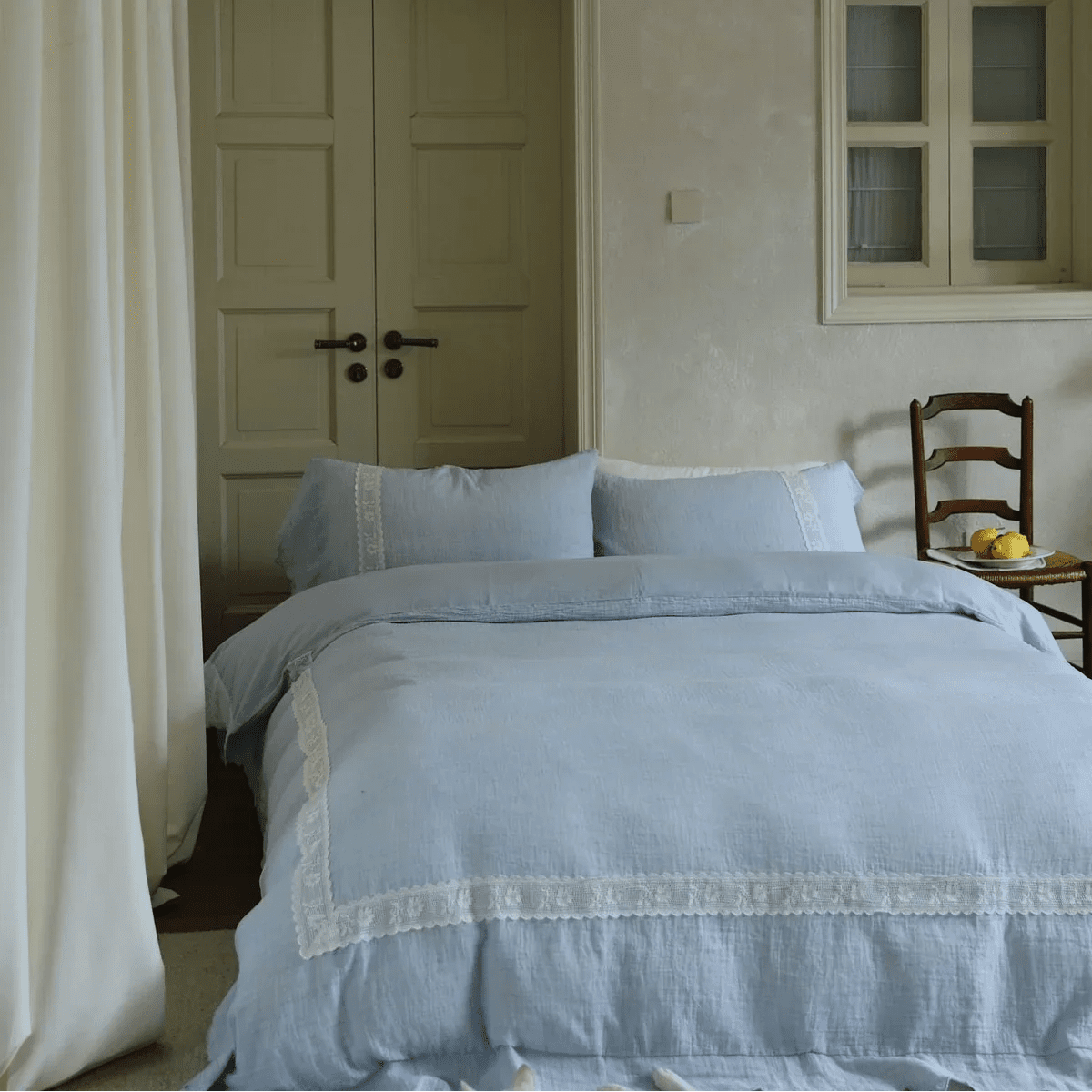
Committing to one consistent undertone across your main textiles, starting with something like Duo Minimal Double Layer Bedding Set as your anchor piece, does more to calm a room than removing decor ever will.
Bedding sets in coordinated, single-undertone palettes


Visible Items Without a System Read as Clutter, Even When Organized


Anything left visible in a room adds to the visual load, whether it's neatly arranged or not. A stack of folded blankets on a chair, a few throws draped over the end of the bed, or loose pillows piled in a corner can all be "organized" in the sense that nothing is dirty or out of place, and still read as clutter because your eye has to sort through all of it at once.
This is a common reason a room can feel cluttered even after a genuine cleaning session. The items didn't disappear, they just got folded and left in the open where you can still see every single one of them.
Ways to reduce the visual load from items left out in the open:
- Limit visible textiles (throws, extra pillows) to one grouped spot instead of scattering them around the room
- Contain loose items in a single basket or bin rather than stacking them directly on furniture
- Rotate out-of-season blankets and extra pillows into storage instead of keeping everything on display
- Fold and stack items so they read as one tidy shape, not several separate objects
Giving loose textiles one contained spot solves this without losing function, and something like the Foldable Laundry Basket, despite its name, can also give throws and extra pillows a home that keeps them accessible without adding to the visual noise.
Storage pieces to tackle a cluttered bedroom


Missing Negative Space Makes Everything Feel Crowded


Negative space, the empty areas between and around objects, is doing more work in a calm room than any single piece of decor. Without it, even a room with genuinely nice things in it feels crowded, because there's nowhere for your eye to rest.
This is often the last thing people think to add, since empty space can feel like a missed opportunity to decorate. In practice, the opposite is true. A wall with one framed piece and visible space around it feels more intentional than a wall packed edge to edge, and a nightstand with room around the lamp feels calmer than one with every inch filled.
Simple ways to reintroduce negative space:
- Remove one item from your busiest surface and leave the space empty
- Choose one wall to stay mostly bare instead of filling every wall equally
- Leave visible space between framed pieces instead of a tightly packed gallery wall
- Resist the urge to fill a newly cleared spot right away, let it stay empty for a week first
A single well-chosen piece, like the Golden Hour Wall Art Poster set against open space does more visually than three smaller items crowded into the same spot.
Statement pieces designed to stand alone


Final Thoughts


If your bedroom still feels cluttered after everything is put away, the fix usually isn't removing more things. It's addressing the five patterns above: visual clutter versus physical clutter, competing focal points, an inconsistent color story, open storage, and missing negative space.
None of these require a full room reset. Grouping a few small objects, picking one focal point, committing to one undertone, closing a cabinet door, and leaving one spot intentionally empty will change how the room feels more than another round of tidying ever could.
If you want to take this further into how the room is organized day to day, check out our Homeware and Furniture Collection as the next step for practical products that keep a room from sliding back into visual clutter.
Summary:
Physical clutter and visual clutter are different problems; a room can be technically tidy and still feel cluttered if there's too much for the eye to process at once.
Too many focal points, a bold headboard, rug, and gallery wall all competing, make a room feel cluttered even when nothing is out of place.
An inconsistent color story, mismatched undertones across bedding, curtains, and rugs, reads as visual disorder even when each piece is nice individually.
Missing negative space is often the real culprit; a room with room to breathe feels calmer than one packed with more decor, no matter how organized it is.
Looking for another Read?


FAQ:
WHY DOES MY ROOM FEEL CLUTTERED EVEN THOUGH EVERYTHING IS PUT AWAY?
Your room likely has visual clutter rather than physical clutter, meaning there's too much for the eye to process even though nothing is out of place. Too many small decorative objects, competing focal points, or an inconsistent color palette can all make a tidy room feel cluttered.
WHAT IS THE DIFFERENCE BETWEEN PHYSICAL CLUTTER AND VISUAL CLUTTER?
Physical clutter is items left out of place, like clothes on a chair or dishes on a nightstand. Visual clutter is items that are put away or organized but still create too much visual information at once, like an open shelf with many small, unrelated objects.
DO I NEED TO GET RID OF THINGS TO STOP MY ROOM FROM FEELING CLUTTERED?
Not necessarily. A room that feels cluttered often just needs more intention, not less stuff. Grouping small items, picking one focal point, and leaving some negative space can calm a room significantly without removing anything you actually want to keep.
WHY DOES OPEN SHELVING MAKE A ROOM FEEL MORE CLUTTERED THAN CLOSED STORAGE?
Open shelving keeps every item visible, which adds to the room's visual load even when everything is neatly arranged. Closed storage holds the same items out of sight, reducing how much the eye has to process without sacrificing organization.
Anything We Missed?
Thanks for reading till the end — we hope it brought a little calm and inspiration to your day.
Discover more: Inspiration Blog · New Arrivals ·
Stay tuned for our next story, or share this one to spread the calm.
♡ Share your makeover moments with #EverLastingMakeover and tag @EverLastingFabric
Connect with us:
Instagram | Facebook | TikTok | Pinterest | YouTube