Design Therapy: How to Make Your Bed the Focal Point of Your Bedroom


Walk into most bedrooms and your eye doesn't land on the bed first. It lands on the window, the dresser, a piece of art, or nothing in particular, it just drifts. That's the real problem. The bed is the largest object in the room, the thing you actually use it for, and yet it's often the last thing your eye settles on.
A bedroom without a clear focal point doesn't feel wrong exactly, it just feels unfinished, a little flat, like the room hasn't decided what it's about. Making the bed the focal point isn't about buying more things. It's about understanding a few design principles that tell the eye where to look, and applying them on purpose instead of by accident.
Here's how to actually do that.
Table of contents
Center the Bed and Let Symmetry Do the Work


Before color, lighting, or layering can do anything, placement has to be right, because an off-center or asymmetrical setup undercuts a focal point before it has a chance to work. A bed that's pushed slightly off-center on its wall, or flanked by two mismatched nightstands, creates a subtle visual imbalance that your eye notices even when you can't immediately say why the room feels off.
Symmetry reads as intentional. It tells the eye "this was designed," rather than "this is just where the furniture ended up." That doesn't mean a bedroom needs to be perfectly matched down to the last detail, but the area directly around the bed, the part that establishes it as the room's anchor, benefits from balance more than almost anywhere else in the space.
How to check and improve placement and symmetry:
- Center the bed on its wall, measuring from each side rather than eyeballing it
- Match the height and scale of pieces flanking the bed, even if the styles differ slightly
- Keep lighting balanced on both sides rather than brighter on one side than the other
- Step back from the doorway and check whether the bed visually "sits" in the middle of what you see
A headboard like the Marshmallow Bed Frame does a lot of this work on its own, since it gives the bed a clear, centered shape to be measured against, making it far easier to tell at a glance whether everything around it is actually balanced or just close enough.
Headboards that anchor the bed and make symmetry easier to see


Give the Wall Behind the Bed a Job to Do


A blank wall behind the bed is one of the most common reasons a bed fails to become a focal point. The eye needs something to travel toward, and an empty wall gives it nowhere to go, so it keeps moving until it finds something else in the room instead, a window, a doorway, anything with more visual information.
This doesn't mean the wall needs art or a gallery. It means the wall needs to visually support the bed instead of competing with it or ignoring it entirely. A deeper wall color directly behind the headboard, a textured paint finish, or even a single oversized piece centered above the bed all do the same job: they give the eye a destination, and that destination is the bed.
What to check about the wall behind your bed:
- Notice whether your eye naturally stops there, or keeps moving past it
- Consider a slightly deeper or warmer tone than the rest of the room on that one wall
- Center anything on that wall to the bed, not to the wall itself, since an off-center piece pulls focus sideways
- Avoid splitting attention with multiple small items; one anchor does more than several scattered ones
A single oversized piece, like this Flora - Whimsical Botanical Illustration Wall Art, does more for this wall than a cluster of smaller frames ever could, since it gives the eye one clear destination instead of several competing ones. Centered directly above the headboard, it reinforces the bed as the point the whole wall is built around.
Pieces that naturally make your bed the focal point


Let the Bedding Carry the Color Story


If the wall gives the eye somewhere to go, the bedding is what keeps it there. This is the detail most people get backwards: they treat bedding as something to match the room, when it should actually be doing more visual work than almost anything else in the space.
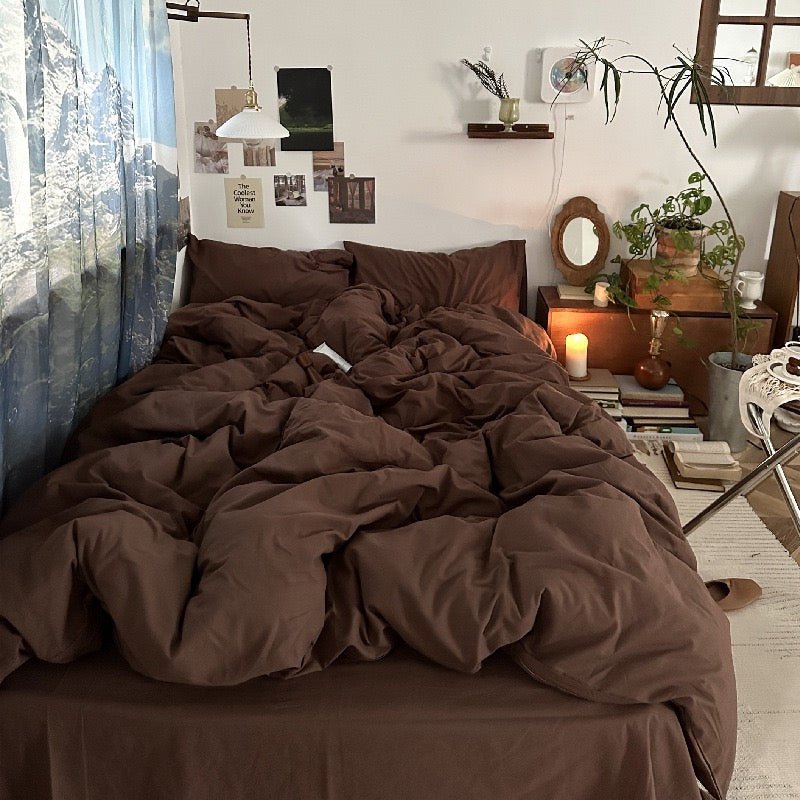
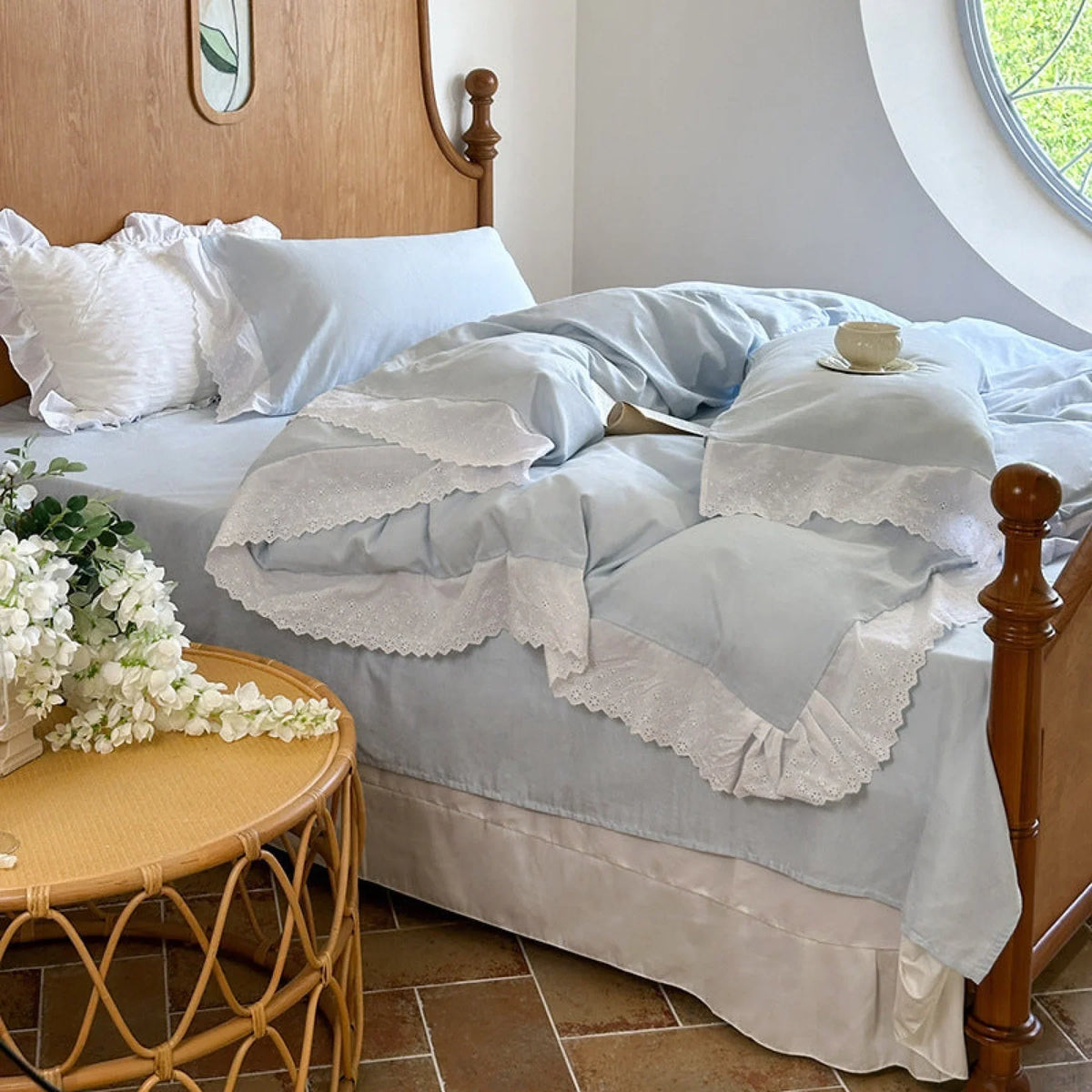
A bed in pale, low-contrast tones tends to recede into the room, even when it's physically the largest object in it. A bed with a richer, more saturated color, or a clear pattern, pulls focus simply because it has more visual weight than the surrounding furniture. This is why a plain white bed in an otherwise colorful room can still feel like the least important thing in it, color intensity, not size, is what the eye prioritizes.
Ways to let bedding do more of the focal-point work:
- Choose one dominant tone for the bed that's noticeably deeper or richer than your wall color
- Avoid matching the bedding exactly to your curtains or other soft furnishings, contrast creates focus
- A patterned duvet or bedding set naturally draws more attention than a plain one, use that intentionally
- Keep the rest of the room's palette a shade quieter than the bed so it doesn't have to compete
A set like the Sienna Double Gauze Gingham Patchwork Pastel Bedding Set works well here because its depth of color does the anchoring on its own, without needing extra styling around it to make the bed stand out. It's saturated enough to hold its own against the rest of the room, which is really the whole point, the bedding shouldn't need help competing for attention.
If going more saturated makes you hesitate because you're picturing extra laundry stress,
"Bedding Myths That Make Bedding Care Feel Harder Than It Is"
is worth a quick read, most of what feels like a maintenance trade-off with richer color isn't actually true.
Bedding with enough color depth to anchor a room


Use Height and Layering to Draw the Eye Upward


A flat bed, one pillow, one thin duvet, reads as low-priority no matter how nice the room around it is. Height and layering are what give a bed visual presence, the same way a tall plant or a piece of furniture with real volume naturally draws the eye before a flat, low object does.
This is partly about pillow arrangement and partly about how the bedding itself is layered. A bed with pillows stacked at varying heights, a folded throw adding volume at the foot, and a duvet with some loft to it reads as substantial. A bed with one flat pillow and a thin top sheet reads as an afterthought, even in an otherwise well-designed room.
How to build height without overdoing it:
- Stack pillows in at least two heights, standard shams in back, smaller accent pillows in front
- Add one folded or draped layer at the foot of the bed to break up a flat horizontal line
- Choose a duvet or comforter with visible loft rather than one that lies completely flat
- Avoid lining pillows up in a single flat row, slight overlap reads as fuller and more intentional
A layering piece like the Helena Jacquard Throw Blanket adds exactly this kind of volume, giving the bed the visual weight it needs to hold its place as the room's focal point. Draped at the foot of the bed or folded over one corner, it breaks up the flat line a plain duvet leaves behind and gives the eye something closer to sculpt.
Layering pieces that add height without clutter


Keep Everything Around the Bed Quieter


A focal point only works if everything else in the room agrees to be secondary. This is the principle most people skip, because it feels counterintuitive, if you want the bed to stand out, surely everything else should look just as nice. But visual hierarchy depends on contrast, and contrast requires something to be quieter.
If your nightstands, wall art, and decor are all competing at the same visual volume as the bed, nothing wins, and the room reads as busy rather than intentional. The fastest way to make a bed feel like the obvious centerpiece is to simplify everything immediately around it, not to add more to the bed itself.
Ways to quiet the space around the bed:
- Choose simpler, lower-contrast pieces for nightstands and nearby furniture
- Limit wall decor near the bed to one or two pieces rather than a full gallery
- Keep nightstand lamps and accessories in tones that blend rather than compete with the bed
- If a nearby piece draws the eye before the bed does, that's the piece to simplify or remove
This is also where a few well-chosen textile touches help more than new furniture does. A tonal throw pillow like the Starry Night Striped Pillow can echo the bed's palette elsewhere in the room, on a reading chair or window seat, without stealing its spotlight. The goal isn't to add more, it's to let anything nearby agree with the bed instead of arguing with it.
Quiet accent pieces that support without competing


Light the Bed Like It's the Subject, Not the Background


Lighting tells the eye what matters before anything else does. A room lit evenly from a single overhead source treats every object with equal importance, which means the bed gets no more visual priority than the dresser or the floor. If you want the bed to read as the focal point, the lighting needs to say so.
This doesn't mean spotlighting the bed. It means using light with intention, slightly brighter near the bed, dimmer at the room's edges, so the eye is naturally guided toward the center of the space instead of distributed evenly across it. Warm, layered light sources near the bed also make the bedding's color and texture read more richly, which reinforces everything the wall and the bedding are already doing.
Lighting adjustments that reinforce the bed as the focal point:
- Place at least one light source at bed height on each side, rather than relying on a single ceiling fixture
- Use warmer-toned bulbs near the bed to make color and texture read more vividly
- Let the edges of the room stay slightly dimmer than the area around the bed
- Dim or turn off overhead lighting in the evening so bedside light becomes the dominant source
A lighting source like the Egg Glass Lamp placed at bed height does more to establish the bed as the room's center of gravity than almost any other single change. With light coming from the sides instead of straight down, the bedding's color and texture read richer, and the whole bed reads as the room's warmest, most considered point.
Lamps that put light exactly where the bed needs it


Final Thoughts


A bed becomes the focal point of a room through a handful of deliberate choices working together: a wall that supports it instead of ignoring it, bedding with enough color depth to anchor the eye, real height and layering, a quieter surrounding space, and light that points toward it rather than spreading evenly across the room.
None of this requires a full renovation. It requires looking at your bedroom and asking, honestly, where does my eye go first? If the answer isn't the bed, one or two of these five principles is usually the reason, and each one is fixable without starting over. If the idea of a more deliberate room appeals to you, our Minimalist Collection would be just right, as that is what it's built around, with each piece chosen to support the bed instead of compete with it.
Once your bed has its moment, let the rest of the room settle into the background where it belongs.
Summary:
A blank or uncentered wall behind the bed gives the eye nowhere to land, which is one of the most common reasons a bed fails to read as a focal point.
Bedding with deeper, more saturated color carries more visual weight than pale or low-contrast bedding, regardless of the bed's actual size.
Height and layering, varied pillow heights, a draped throw, visible loft, give a bed the physical presence a flat, single-layer bed lacks.
A focal point only works in contrast; simplifying what's immediately around the bed matters as much as styling the bed itself.
Looking for another Read?


FAQ:
WHY DOESN'T MY BED FEEL LIKE THE FOCAL POINT OF MY BEDROOM?
Usually it's one of a few things: a blank or off-center wall behind the bed, bedding that's too pale or low-contrast to carry visual weight, or lighting that treats every object in the room equally instead of prioritizing the bed. Identifying which one applies is the first step to fixing it.
DO I NEED TO PAINT A WALL TO MAKE MY BED A FOCAL POINT?
Not necessarily. While a deeper wall color behind the bed helps, the same effect can come from centering a single large piece above the headboard or simply simplifying everything else near the bed so it stands out by contrast rather than by paint.
WHAT ROLE DOES BEDDING COLOR PLAY IN MAKING A BED THE FOCAL POINT?
A significant one. Pale, low-contrast bedding tends to recede visually, even though the bed is the largest object in the room. Richer or more saturated bedding colors carry more visual weight and naturally draw the eye, which is part of why two bedrooms with the same layout can feel completely different depending on bedding choice.
HOW DOES LIGHTING AFFECT WHETHER A BED READS AS A FOCAL POINT?
Lighting signals importance. A single overhead light treats every object in the room with equal visual priority, which flattens the bed's presence. Layered lighting that's brighter near the bed and dimmer at the room's edges guides the eye naturally toward the bed as the room's center.
Anything We Missed?
Thanks for reading till the end — we hope it brought a little calm and inspiration to your day.
Discover more: Inspiration Blog · New Arrivals ·
Stay tuned for our next story, or share this one to spread the calm.
♡ Share your makeover moments with #EverLastingMakeover and tag @EverLastingFabric
Connect with us:
Instagram | Facebook | TikTok | Pinterest | YouTube